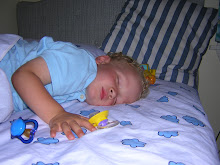
Friday, July 29, 2011

Some valuable information on Co-Sleeping and Breastfeeding

One of our alert readers directed us to this article on the virtues of co-sleeping especially when breastfeeding.  And we say: if it works for you, then go for it.  Just please, please, please follow the basic rules that we outlined earlier: no gap between the headboard and mattress; no excess of bedding; no exceedingly soft surfaces; baby positioned to sleep on her back.

Another thing with all of the recommendations that Denise and I make here: if you don't view sleep as an issue, then it's not an issue.  So, if you, your bedpartner and your child are all comfortable and are not experiencing daytime fatigue and all feel that the amount of sleep that each of you is getting is adequate, then you don't have a problem.  If you have a problem (frequent awakenings during the night unrelated to feeding an infant; excessive daytime sleepiness; infant with slow growth), then the co-sleeping situation should be examined to see if changing it changes the issues.

As opposed to Gisele Bundchen dictated that all mothers should always breastfeed their babies for at least a year and every mom who either failed at breastfeeding or returned to a job outside of the home freaked out, we, the Sleep Tech Moms, recognize that there is a unique solution for sleep for every family and that there are as many iterations of sleeping as there are families.  And while, as sleep techs, we are always prepared to glue wires all over the head of anyone who sits still long enough for us to do so, we are aware that the sterile environment of the lab is not necessarily how people sleep in their homes.

So there.

Tuesday, July 26, 2011

New info on SIDS

So, we inadvertantly (well, at least unintentionally) opened a small can of baby worms with our last post.  Here is a VERRRRY academic article on SIDS that is quite thorough in its analysis.  And, if you skip through most of the parts with the really big words and any part that says "pathophysiologically" or "biomarkers" or what have you and skip to the summary, there you will find that the author has listed out the risk factors for SIDS.  As with so many diseases and disorders of infancy, Being Born Poor is the worst thing that a baby can do.  Being Born Poor and to a mother who smoked during pregnancy and into a household where there is tobacco smoke and in which baby is put to sleep lying on his belly or on a couch is even worse.  So, while co-sleeping is mentioned, it's not the devil that our last post may have been interpreted to say it is.

Another separate post on co-sleeping will follow, however, it is our feeling that the best place for newborn babies (less than 12 weeks) is in the parent(s)'s room in a separate spot for baby (e.g., bassinet, baby basket, etc.)  Apparently, it is no longer considered safe to do as Trixie did with her Little Ones, which is to put them in their car seats.  Here is an article published in the journal Pediatrics in 2009 that showed lower oxygen levels for two day old infants placed in car seats versus beds.  While the study isn't controlled all that well, the evidence here does suggest that sleeping long-term in a car seat is not ideal.  A brief review of the chat rooms out there showed that many parents do use the car seat, especially when dealing with reflux.

Finally, if you do decide to bring Baby into your bed, remember to make sure that there is no loose bedding (pillows, covers, the Sunday Times) that could cover Baby's face.  Check that there isn't a Baby-size gap between the headboard and the mattress.  Place Baby on her back, preferably on the mattress, and never on anything too soft (like a comforter.)

And always remember to discuss sleep with your pediatrician!

Sunday, July 17, 2011

No, No Newbies!

DO NOT let your newborn infant sleep with you in your bed!  The voice in your head telling you not to is not a paranoid voice, it is a sensible voice, eked out from millennia of evolutionary progress.  Put your newborn in her car-seat thingy and set it on the floor next to your bed or put him in a laundry basket on HIS BACK next to your bed but DO NOT sleep with your infant in your bed.  Especially not with your and your equally sleep-deprived partner.  It seems sort of dangerous because it is sort of dangerous.  And yes, sleeping in the parental bed is a CAUSE of Sudden Infant Death Syndrome.  The baby can be in your room, in arm's reach, and NOT in your bed.
Here is what the Mayo Clinic has to say on the subject of SIDS.

Again, we are sleep techs and understand sleep deprivation.  Please, please put your infant to sleep somewhere other than your bed.

Wednesday, July 13, 2011

Dr. Dennis Rocks!

We are chagrined that we didn't post this link earlier:
Dr. Dennis Rosen weighs in on study in the journal Pediatrics

We have said it before and we will say it again: turn off the teevee!  Television is stimulating to kids, even if they appear zoned out.  There is no reason to have a television set in a young child's bedroom (and we are against television in anyone's bedroom since bedrooms are for sleeping (and possibly for canoodling, but this is sleep therapy, not sex therapy, so we won't go there.))

Recently, Trixie's pre-schooler has fallen asleep while Trixie read to him in his bed.  While this may be because Trixie is really boring and chose excerpts from a medical textbook to read, it still is really a lovely thing to have your child curl into you and be lulled to sleep by the sound of your voice.

Save the tube time for when you are doing something important, like surfing the Internets or updating your Facebook profile.  Bedtime is not screen-time.

Tuesday, July 12, 2011

That's the Way the Cookie Crumbles

So, Denise walks into work last night and is confronted with a four year old, who, according to his mother, will not go to sleep, will not go to sleep without the television on, is being worked up for ADHD (did we mention that this child is FOUR YEARS OLD?) and will not stay in his own bed.  Denise introduces herself to Little Jakey (not his real name) and notices cookie crumbs all around the cherub's mouth and on the bed.  Not JUST cookie crumbs, mind you: these are OREO crumbs.  Which are made of chocolate.  Which is like giving a four year old, who is coming to a HOSPITAL for a SLEEP TEST, a double espresso.  Denise is able to get Jakey to go to bed with lights out and TV OFF at 9:15 (despite protestations from Mom.)  Jakey sleeps through the night with very few awakenings: a normal sleep study.  Mom also noted that, at home, Jakey is put to bed at 8PM and is awakened at 7AM.  For this kiddo, that is too much sleep.  Pushing bedtime back by an hour should assure that Jakey will sleep through the night.  Additionally, at home, when Jakey awakens, he goes into the parents' bed and is allowed to stay because THEY ARE TOO TIRED TO PUT HIM BACK IN HIS BED.  Newsflash: he ain't gonna go on his own, sistah.

So, what have we learned here?

  • Oreos are only to be eaten by the Sleep Technologists, who are very hungry.
  • It is OK to be a parent and to say things like "I am turning the TV off now" and "I am going to put you back in your bed now."  Especially when the child in question is FOUR YEARS OLD!
  • If a child is exhibiting symptoms of hyperactivity, cut back on the sugar.
  • A child's bedtime is not predicated on when the parent is tired of the child; it is predicated on when the child is tired.

Monday, July 11, 2011

What you'll do on your Summer Vacation

If you are lucky enough to have a vacation scheduled this summer, here are some things to remember when you take your Little Darlings along.  If you have figured out how to have a vacation without dragging the LD's with you, please let us know.

If your child's sleep schedule changes while you are on vacation (whether it's a time zone change or a later bedtime or addition of naps on the beach or any other change), you will pay for it when you get back home.  So, don't expect your child to automatically resume a pre-vacation bedtime routine just because you have to go to work on Monday.  No, no, no.

If, for example, you allowed those cherubs to stay up late and, in turn, sleep in late, you will need to reestablish the routine sleep schedule when you return home.  Bad news here: it may take a week or two of gradually moving the clock back and it will depend on just how lenient you were while on vacation.  If your kiddos usually go to bed by, say, 9PM with a wake-up time of 7AM and, during your week at the Cape, they stayed up until 11:30 and then slept until 9AM, you need to move the whole schedule back two hours.  This will not go over well and you should not try to do it all at once.  However, allowing them to stay up and then yanking them out of bed to go off to camp or child care at the usual early rising time will backfire on both of you in a big way.

The best thing to do is to avoid changing the usual sleep-wake times by too much while you are on vacation.  The less change there is, the easier it will be to get the critters back on routine when you get home.  Which we know may be easier said than done.

Just keep in mind that if you get home from a week away only to find that your kids are miserable and even more disagreeable than usual, you may want to check on the bedtimes.

And don't forget the sunscreen!

Wednesday, June 22, 2011

Art imitates life. Again.

Denise worked with another patient last week: an adolescent male with ADHD and difficulty initiating and maintaining sleep.  As she always does, since she is perfect, Denise reminded the patient and parent that there should be no chocolate or caffeine consumption prior to lights out and that lights out would be at 10PM.  The patient's father was aghast, since the patient would not, could not, will not go to bed before 1AM.  Sleep Lab rules, Denise said, in the nicest way imaginable.  Let's try it this way for tonight.

A little later, Denise returns to the patient's room only to find crumbs that look suspiciously like CHOCOLATE littering the bed.  Oh, says the patient, I had my nightly CHOCOLATE POP TART.  Um, what was it about "no chocolate" that you didn't understand?  And, Trixie would like to point out, Pop Tarts are the work of the devil and contain nothing but chemicals and high fructose corn syrup, which are bad for you.

Anyhoo, after applying the usual 1000 electrodes and sensors to the patient, Denise prepares the patient for lights out.  And this boy, with his chocolate Pop Tarts and ADHD and inability to fall asleep before 1AM, gets out his cell phone and his iTouch and his Nintendo DS and prepares to fall asleep as he usually does: that is, by NOT sleeping and by STIMULATING his brain with all of this electronic paraphernalia.  So, Denise, bless her heart, turns all of the stuff to the OFF position and leaves the patient and his father sulking.

Lo and behold, the patient was asleep within FIFTEEN MINUTES.  Yet another cure for the Sleep Tech Moms.

Monday, June 20, 2011

Free Advice that is actually valuable

If you haven't subscribed to Baby Center, they have some good and practical advice on kids and sleep.  This link is on babies and includes tried and true Trixie and Denise methods like: if the diaper isn't leaking onto your hands, don't change it; turn off the lights; and Denise's fave, lose the baby monitor.

It really is just common sense!

babycenter

Saturday, June 18, 2011

Friday, June 17, 2011

Perfect Example

In yet another instance of life imitating art (or something like that), Denise had a wonderful example of sleep environment meets medical condition at work the other night.  A set of adorable male twins, age 2 (every sleep tech's nightmare: two is the very very very hardest) came in for a sleep study.  Denise, since she is perfect in every way, had read the patient charts ahead of time and knew that the instructions were that the little lads needed to be in bed NO LATER THAN 7PM!

Denise rolled her eyes and got to work early to accommodate these little darlings, even though she had already diagnosed them as "GOING TO BED TOO EARLY".  Chief complaints of the parents of these sweet boys were "restless sleep, awakening before 6AM."  Additionally, seasonal allergies were noted and snoring was reported.

Denise noted that Twin 1 had an essentially quiet night and that Twin 2 exhibited snoring and position changes.  Denise's diagnosis: Twin 2 is waking Twin 1 with his snoring.  Mom corroborates this theory by telling Denise that the twins do yell and talk at night.  Denise thinks to herself and refrains from saying out loud "Twin 1 is yelling at Twin 2 to stop making noise!"  Parents also note that maybe they should put the kids to bed a bit later, but that they (the parents) NEED TIME TO THEMSELVES.

So here, it is important to reiterate, if you have children, you will get time to yourself when your children are 60 years old and not a moment before.  Unless you have a full time nanny and housekeeper, in which case we probably don't want to know you.

Also, it is important to point out, that Twin 2 has a crowded airway and will likely have his tonsils removed.  Which will make Twin 1 very happy.

Tuesday, June 14, 2011

Just a little more on Newbies...

Lest we forget, those of you who give birth prior to your due date (especially those of you who insist on giving birth to preemies) and those of you who have little ones who come into the world a little unwell (whether it's jaundice, reflux or something more serious) can expect the calendar for sleeping to be pushed back even a bit more.

If your bun came out of the oven too soon, remember to count developmental age from his or her due date, not from the birth date.  And don't expect consistent sleep if your Muffin is battling a medical condition, whether the condition is short-term or long-term.

Sorry for the tough love: no one understands sleep deprivation like a sleep technologist, since it is a job hazard for us.  Sometimes, though, knowing what to expect is half the battle.

Monday, June 13, 2011

Newbies

Trixie has four friends who are newbie parents.  So, that got us thinking about infants and how much they sleep and how we will frequently hear newbie parents tell us that they are going to put their infant on a schedule.  And how we then nod politely before leaving the room and doubling over with maniacal laughter.

If you try to put your newborn infant on a sleep schedule, it will fail miserably, UNLESS the schedule that you decide on is the one that came with the infant.  Remember that your little bundle has been developing sleep habits during fetal development and that is not going to change just because the bundle no longer resides in utero.

When baby arrives, he or she will sleep as much as 18 hours per day, usually in 4-6 hour increments.  If your friend's mother's cousin's sister-in-law's baby slept through the night from birth, please note that she was LUCKY and that that is extremely uncommon behavior.  Or, perhaps this baby's parents are putting whiskey on the binky, like Trixie's parents did so long ago, but that, of course, is another story.  For the first month, baby will sleep when he or she feels like it and you should sleep then too.

Waah.  Waah.  We know you have jobs and responsibilities and need time to do 100 loads of laundry stunk up with milk puke.  Trust us: learn to nap and learn to go to bed early.  That's why God invented TiVo.

REM sleep, or dream sleep, starts at about six weeks of age.  Coincidentally, that is also around the time that a baby learns to smile.  So now, if  you are ever on Jeopardy and there is an "Arcane Sleep Factoids" category, you can use that.  Also around this time, babies shorten the amount of time they sleep each day and may even stay asleep for longer periods of time.

Three months of age is the earliest that you should expect to have success with a sleep schedule, since that is the earliest that a baby is likely to sleep for six hours or so at night.  And if you think that the NKOTB is going to stay asleep longer than that, well, I have news for you: that's what his teenage years are for.  It's not gonna happen.

So, instead of setting up unachievable expectations, just settle in, learn to take naps and adapt your schedule to baby's instead of expecting it to work the other way around.

Sunday, June 12, 2011

A few thoughts about the wickedly funny new book out there

http://articles.boston.com/2011-06-11/ae/29647783_1_parents-hostage-small-publisher-akashic-books

Since Denise and I are perfect in every way and, as Real Actual Profession Sleep People, have never ever had a night in which we even thought of shrieking "GO THE FUCK TO SLEEP!" (oops, pardon me), we understand that parents less perfect that we are may have considered, or even actually stated, those very words.

We think that the book is AWESOME in that it allows parents to admit that they have an issue.  But people, really, the way to address the issue is not by adding more and more complicated routines.  For example, we would recommend that the little lad featured in the article not be put to sleep in a Superhero costume, since a Superhero costume would, perhaps, send a message to the child that he or she can Leap Tall Buildings or Fly Faster than a Locomotive.  We might also suggest that, since this child routinely fights going to bed at his current bedtime and then awakens early in the morning, that the parents consider moving his bedtime back by 30-60 minutes.  Of course, I know that this darling child's dad is itching to grab the remote to watch the Sox and that his mom has had her hand on that bottle of wine since 6:30PM just waiting to pour, but maybe, just maybe, and extra half hour of specified wake time will make Superman more tired and ready to actually go to sleep.

Just saying.

We are also so happy that our Mentor and Hero, Dr. Dennis Rosen, weighed in with some common sense advice.  Thanks Dr. Dennis!

A new post, in which Trixie is aghast

One of Trixie's little darlings had a play date the other day with a pair of twins at his pre-school.  The twins are awesome: really great little guys.  When Trixie arrived to pick up her own LD, she saw that in the twins' bedroom, lining both adorable little beds, were rows and rows of STUFFED ANIMALS!  Trixie believes (and has scientific data behind her on this) that stuffed animals harbor DUST MITES and bacteria and dirt and lots of other yucky things.  Trixie remembered the twins' mom telling tales of upper respiratory woes and could barely restrain herself from grabbing all of the stuffed animals and shoving them into a plastic bag and taking them to the nearest Dumpster.  Harsh?  Perhaps.  However, while a stuffed animal or two can be a nice transition item for a child, three or more is a crowd of really icky and truly hazardous GERMS that get into the respiratory tract and cause all of those sniffles and coughs and repeated bouts of upper respiratory infection that, in turn, lead to disrupted sleep.

So, sorry to come back after a few months and get all snarly on you, but if your child has allergies or coughs at night and awakens from coughing, LOSE THE LOVIES.

Tuesday, October 26, 2010

When the tables are turned: Trixie's adventures when her son gets his tonsils out

Denise and I have met parents who are so scared of putting their child through surgery to remove tonsils that they overlook how awful things are for their chid without the surgery. So, we see kids who desperately need their tonsils removed and whose parents, with the best of intentions, have convinced themselves that a tonsillectomy is worse than disrupted sleep, fatigue, failure to thrive, repeated bouts of infection and subsequent antibiotics, etc. This is a case of the devil you know not being as bad as the one that you don't know.

Trixie, of course, is not one of these parents. When her darling son had his second bout of strep throat and Trixie performed a complicated medical procedure called"looking at the back of his throat with a flash light" and saw that her DS's tonsils were the size of small plums, she pleaded with her pediatrician to consider tonsillectomy. After six more bout of strep, one of which migrated to Trixie herself, she scored a visit to the otorhinolaryngologist or ear' nose and throat doc. Thinking that she had finally found an advocate, since this man presumably feeds his children by removing the tonsils of other children, Trixie was shocked when the surgeon suggested that"we do not remove tonsils because they are large". The poor little darling had to get strep yet again to be taken seriously.

So, what am I talking about? Well, two things, I think. One is that, if your child has a chronic condition that is affecting his or her sleep, then get the problem fixed. The effects of long term insufficient sleep in a child is very serious and, if the cause is big tonsils, then resolving the issue is relatively simple.

The second is that sometimes you really need to be an advocate for your child and that may mean ditching Miss Manners and being downright pushy.

Monday, August 23, 2010

We Know Who this is REALLY About

Why, YOU, of course, sleepy parent.  We know that the reason you are concerned about your child's sleep is because it impacts your own.  Trixie remembers taking a class for New Moms when she herself was a new mom and listening to another class member complaining about her baby's sleep pattern.  The little tot was going to bed at 8 and was waking at seven or seven-thirty in the morning.  The rest of the class was shocked to hear that a baby would actually someday maybe perhaps sleep through the night.  But not this mother.  No, no, no.  She had always slept until 8:30 or 9 in the morning and didn't understand why the baby wouldn't sleep later.  So, the rest of the class immediately got up and strangled her for being so, um, STUPID.  And SELF-CENTERED. 

However, once cooler heads prevailed, that mom's desire to go back to her old life of sleeping until 9AM started to sound less selfish and more like, um, the rest of us.  Whether it's sleeping in or peeing with the bathroom door closed or eating in a restaurant without a children's menu, we all give up a lot for our kids.  And when we are sleep deprived, it makes it that much harder to deal with all that we've sacrificed.  So, the sleep patterns of those little darlings become even more important to us to control.

If your children, like Trixie's, wake up at the CRACK OF DAWN, it's okay to push bedtime back a bit.  It is our belief that all children under the age of 12 should have a bedtime of no later than 10PM.  For kiddos under the age of 6, it should be by 9PM.  If your kids don't have issues with sleep other than waking up early just to DRIVE YOU NUTS, then push bedtime back by half an hour or so to keep them asleep past the rooster's first crow.

An actual informative discussion of sleep scheduling could take another entire post, so we will leave it here for now, with more to come on scheduling.

Tuesday, August 17, 2010

Don't Fall Victim to SPS!

Denise and I frequently observe a phenomenon that is common enough that we have decided to name it as a syndrome: Stupid Parent Syndrome.  Sadly, it seems that even non-stupid parents can succumb to SPS and that sleep-deprivation can lead to SPS.  Here are some symptoms and some suggestions on avoiding this syndrome.

The major finding of SPS is doing almost anything that a child requests.  This includes and is not limited to these symptoms:
  • Feeding the child sugar close to or after bedtime
  • Allowing a child under the age of 10 to drink caffeinated beverages, including Mountain Dew or a Starbucks Mocha (chocolate and espresso, in case you don't know)
  • Allowing the child to dictate his or her bedtime
  • Agreeing with the child when the child states that he or she Will Not Go to Sleep
  • Supporting the child when the child insists that he or she Needs TV to Fall Asleep
  • Jumping out of bed everytime a baby (over the age of 6 months) makes a noise and then MOVING the baby around to make sure he or she is okay thus WAKING the baby.
Here are some ways to avoid SPS:
  • Set rules for bedtime and MAKE YOUR CHILDREN FOLLOW THE RULES
  • Do not feed your child sugar or espresso or caffeine, especially not within 4 hours of bed
  • Remember that YOU ARE THE BOSS OF THEM
  • Keep in mind that babies have been sleeping for MILLENNIA without constant observation, so your baby will be fine, too (rule of thumb here: if your baby (over the age of six months) got herself into a position, she can get herself out of it)
  • NO ONE needs TV to fall asleep.  Humans fell asleep without the use of televisions for many years (at least according to Trixie's husband, who was born in the 1950's and is therefore Old) and there has been no detectable change in the genetic code that supports the need of TV to initiate sleep in the Modern Human.
Remember that you are in control (even when that doesn't appear to be the case.)  So, you have the POWER to make all of this happen.  There, you are now an official Superhero. 

Oh, wait, we can hear you already:
"My three-year old will not go to sleep without the TV on.  He demands that the TV stays on until he is asleep."

Really?  He "demands" it?

We think not.  We think that you have allowed it to happen and that this may be how it happened:
Once, when you were VERY tired and the little bugger WOULD NOT GO TO SLEEP, you allowed him to stay up watching TV until he fell asleep and then you put him to bed.  Then you went to sleep and it was good.  So, the next night, when Jakie threw a tantrum, you may have succumbed to the innocuous sound of the theme song from the Backyardigans again.  And then, in order to avoid those bedtime tantrums, a pattern was established and now the cunning, clever little tot gets TV EVERY NIGHT.

So, the pattern was established.  Now, my friend, it's time for a new pattern.  Remember that it only took a few nights to make the old pattern and it will only take a few nights to make the new pattern.  IT WILL NOT BE PRETTY: there will be tantrums and drama and angst and exhaustion.  And then there will be a new pattern, without a TV or a sugary snack or whatever else it is that your darling says she cannot sleep without.

So, Superhero, go forth and conquer the bedtime hour!  Use your new Superpowers to avoid SPS!

Sunday, August 15, 2010

So What Does Weight have to do with Sleep Apnea anyway?

Good question. And, since we know everything, we will attempt to answer it and will follow with a little about one of Denise's recent patients.

If your child is overweight, his or her lungs can't move as well in the chest. That's because the big belly is pushing up against the diaphragm and the diaphragm needs to be able to move up and down to pull air into the lungs. The other thing that happens is that there is extra *stuff* (the technical term is "tissue") in the back of the throat, at the entrance to the pipe that goes to the lungs. So, during sleep, the number of times that you breathe in a minute decreases PLUS the diaphragm is having trouble moving down because it's being pushed up by belly fat PLUS there's extra stuff in the back of the throat. Not good. But wait, there's more! During dream sleep, all of the voluntary muscles in the body are paralyzed; the diaphragm is not a voluntary muscle, but all of the muscles in the ribcage and neck are and so they can't help the diaphragm out. So, now, there's lots of extra stuff flapping around in the back of the throat, the diaphragm is compressed by the belly fat, and there's NO ONE AROUND TO HELP. This makes for a BAD SCENE. BTW, the stuff flapping around in the back of the throat usually makes a noise, for which the technical term is SNORING. Write that down. (just kidding.)

So, in the pediatric sleep lab at the World's Greatest pediatric hospital, we see lots of overweight kids who snore. And sometimes we can get a little lazy (especially since we know everything) when we see an overweight kid come in and we want to leap to the conclusion that the patient has obstructive sleep apnea. And, a lot of the time, we would be right.

However, as Denise discovered the other night, there is a reason that we get paid the big bucks to stay awake all night long watching our little angels sleep: sometimes the overweight kids don't have sleep apnea and are tired in the daytime or have disturbed sleep patterns for another reason.

Denise's patient was 3 years old, about 36 inches and 80 (EIGHTY) pounds. In kids, a general rule of thumb for the first 6 years or so, is one pound per inch, so we see lots and lots of cute toddlers who are 36 inches tall and weigh 36 pounds or 5 year-olds who are 48 inches tall and weigh 50 pounds or so. This child's (can I say Butterball?) BMI was 43, well into the obesity arena. While talking to the patient's mom, Denise found out that the 3 year-old was still getting a bottle at night. Bad enough, but wait, there's more! When our beloved little Butterball awakened in the night, she was given MORE MILK. So, she was drinking about 24-32 ounces of WHOLE MILK at night, every night. Denise asked Butterball's mom why she wasn't given water and mom said it was because Butterball liked milk. Well, we like martinis, but we know not to drink 24 ounces worth of them after bedtime (that's what cocktail hour is for.)

So, Denise convinced Mom of Butterball to forgo milk for the night and to just give her water if she was thirsty. And, lo and behold, once our beautiful BB got some water, she didn't ask for another bottle, slept through the entire night and DIDN'T HAVE SLEEP APNEA.

The moral of the story? Damned if I know. HOWEVER, if your child gets up frequently during the night, remember to revisit what you're doing to get the little darling back to sleep or you could be conditioning your sweetiepie to demand something that, while okay as an infant, isn't okay as a child or toddler or college freshman.

And if you want to wake Trixie with a martini, please remember the olives.

Saturday, August 14, 2010

An Apple a Day

Since Denise and I are perfect and know everything (just ask Trixie's Darling Husband), we know that you may have some actual real questions about when you should take your Little Darling to see the doctor. Like most of what we've written here so far and will write in the future, the answer is deceptively simple: if you are concerned about your child, you should talk to your pediatrician about it. If this is easier said than done, then you need to find a different pediatrician.

You and your pediatrician's office should be partners in crime, with the singular goal of getting your child to the age of eighteen without major physical damage (it is your singular job, as the parent, to keep said child clean, in school and out of jail.) If you don't feel like you are part of the pediatrician's team in this respect, then you should look for another office. And that's not terrible or bad or mean to the doctor. Remember this about doctors: almost all of them are HUMAN BEINGS, just like you. So, it might be a personality issue or a convenience issue with the office; bottom line is that you need to be comfortable with and able to communicate with your child's doctor.

While keeping in mind that you should call your doctor's office for anything that you feel is concerning, here are a few of the many reasons to call regarding sleep issues:
  • You have seen your child stop breathing during sleep (we hope that that was a no-brainer)
  • Your child consistently wakes up with a headache
  • Your non-teenage child complains of being tired on a daily or near-daily basis
  • There is a major change in sleep patterns (waking during the night; unable to wake in the morning; unable to fall asleep at night).

Friday, August 13, 2010

A Little Bit About Sleep

We, of course, know everything that there is to know about sleep, since we are official sleep technologists. We could, of course, regale you with stories of the suprachiasmatic nucleus and hypnagogic hallucinations, but that would just be showing off. Parents of our patients in the sleep lab, and sometimes the patients themselves, often ask us about sleep: when does deep sleep happen? When does dreaming sleep happen? Are deep sleep and dreaming sleep the same? So, for all of us who relied on Cliff Notes, this is what you need to know about sleep:
  • We all need sleep, especially parents, who may need it just to get away from the kids for awhile
  • Chemicals in our bodies keep us awake and put us to sleep, sort of like naturally occurring coffee in the morning and wine at night
  • Once we fall asleep, we go through a repeating pattern of light sleep-deep sleep-dream sleep
  • This pattern is very easy to see in kids. Just ask anyone who has ever taken a toddler who has been asleep for more than 30 minutes, changed the toddler's diaper and forced his body into footie jammies while he remained asleep.

That, friends, is pretty much all you need to know about sleep.